 +1 562-254-5145

CPG brands and distributors still face a common problem. Their field teams complete shelf audits in one tool, then have to move to a spreadsheet or separate app for reorders. The constant switching leads to delays, data gaps, and missed revenue.
A proper retail execution platform should solve this. It needs to bring audits, planogram checks, ordering, and delivery together in a single mobile app.
This comparison looks at five platforms. Each covers different parts of the field operations process. A couple specializes in audits and visibility. Some are built into bigger enterprise suites with long implementation times. Others link audits and orders reasonably well but lack complete DSD or route planning features.
Here’s how the top 5 compare at a glance:
| Platform | Best for | Founded | Notable specialty |
| SimplyDepo | Unified CPG workflows | 2022 | Retail execution + DSD in one app |
| Pepperi | Enterprise B2B commerce | 2012 | Full-stack suite with trade promotions |
| Repsly | Merchandising teams | 2008 | AI-powered shelf audits |
| GoSpotCheck | Task-driven field ops | 2011 | PhotoWorks AI image recognition |
| Skynamo | International field sales | 2012 | Multi-region, multi-currency support |
Why CPG Teams Struggle With Fragmented Tools
Fragmentation continues to be a major drag on CPG field operations because most teams rely on a patchwork of separate tools rather than a unified system. They often combine an audit app here, an order entry tool there, and an independent route planner for deliveries, hoping the pieces will work together smoothly.
In reality, the missing connections between these systems create repeated points of failure that waste time and reduce effectiveness.
When a rep finishes checking shelves and notes empty SKUs, they still need to switch to a different application to capture the reorder. Without any data integration, this means typing in the same details again by hand, which opens the door to mistakes and omissions — especially on busy days when the rep might skip the extra step entirely due to time pressure.
The downstream effects are significant. Out-of-stocks last longer and eat into sales, while district managers get incomplete pictures from their dashboards, seeing audit activity without confirmation that orders were placed.
As teams scale from small groups of ten reps up to fifty or beyond, these manual workarounds become increasingly difficult to maintain and ultimately break down.
Tools for In-Store Execution and Sales
Choosing the right tool can separate a strategy that looks good in theory from one that actually boosts revenue at the shelf.
The platforms covered here allow CPG brands and distributors to manage their field teams more effectively, capture orders quickly, audit displays, and keep products available where shoppers expect them. Here’s a practical comparison of the leading options designed for in-store success.
1. SimplyDepo
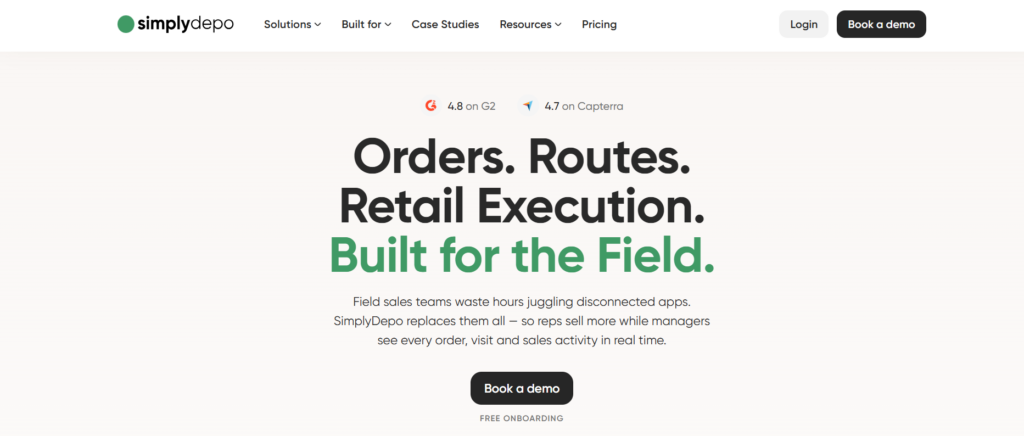
For CPG brands and distributors in North America, SimplyDepo offers something unique: a single platform that brings retail execution, field sales, and DSD workflows together for SMB and mid-market teams.
The mobile app handles the full range of daily tasks — from shelf audits and planogram checks to photo reports, in-store demos, order capture, route planning, van sales, and invoicing. It also syncs directly with QuickBooks and Shopify.
Launched in 2022, the platform was created to solve a practical problem. It lets the same person handle an audit and immediately turn that into an order, plan the next route, and update accounting — all within one reliable offline app.
With AI features built for CPG, SimplyDepo helps teams forecast demand, identify strong and weak products, improve routing, and catch compliance issues fast. This keeps everything connected and cuts down on manual work between teams.
Pricing is straightforward at $89 per rep per month, with no annual contracts, no setup fees, and a 30-day free trial that includes free training.
Core capabilities:
| Feature | Description |
| B2B Order Management | Order capture, quotes, invoicing, returns |
| Retail Execution | Shelf audits, planogram compliance, photo logs |
| Route Planning | DSD route optimization and delivery tracking |
| Route Optimization | AI-driven route efficiency and demand forecasting |
SimplyDepo’s weakness is geographic scope: it is limited to the US and Canada and not designed for multi-region, multi-currency, or multi-language deployments across EMEA or APAC.
Who Should Still Choose SimplyDepo
SimplyDepo is the strongest fit for SMB and mid-market CPG brands in the US and Canada that need to consolidate multiple tools into one mobile workflow. It is ideal for teams doing store visits, merchandising audits, and DSD deliveries. Pricing is transparent and built for SMB budgets.
2. Pepperi
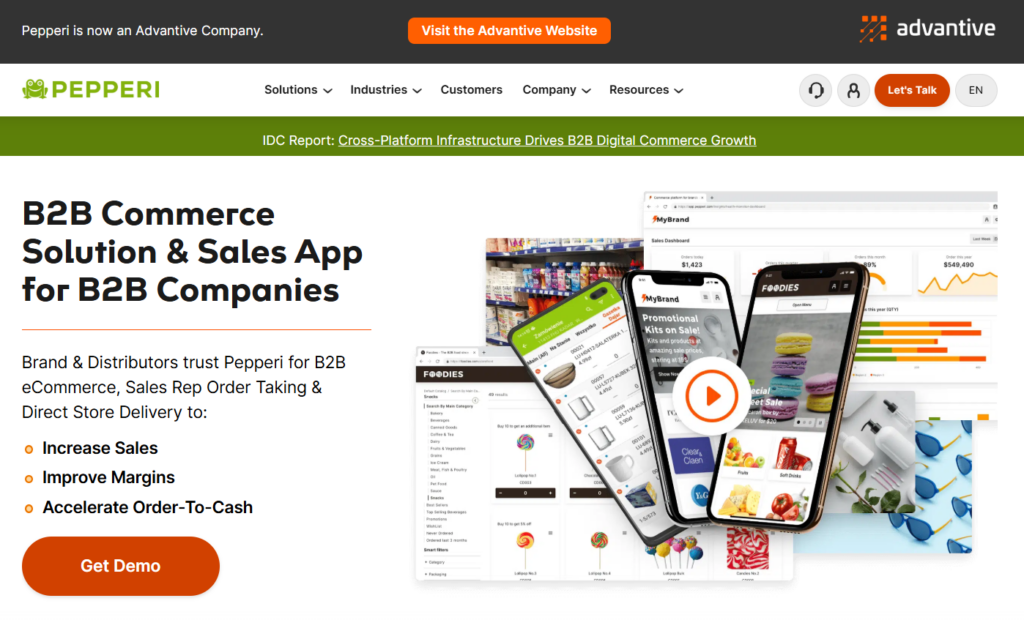
Pepperi is a unified B2B commerce suite aimed at mid-sized and large wholesale distributors. It bundles retail execution, field sales, van sales, and direct store delivery into one practical platform.
The company was founded in 2012 and offers a strong mix of B2B eCommerce portals, mobile order capture for field teams, and solid DSD support. This makes it suitable for businesses with more complex sales and distribution setups.
On top of that, Pepperi provides modules for trade promotions, mobile CRM, inside sales, and customer support. These help manage everything from initial customer contact through to fulfillment and invoicing. It connects with third-party tools and serves a range of industries such as food and beverage, FMCG, and health and beauty.
Pros:
- Full-stack B2B commerce with retail execution included
- Trade promotions and multi-channel order management
- Scalable for enterprise-level operations
Some users note back-office performance issues and slow resolution of bugs or system errors. (Capterra reviews)
Who Should Still Choose Pepperi
Pepperi is the right choice for mid-sized and enterprise wholesale distributors that need a scalable, all-in-one B2B commerce solution with trade promotions, multi-channel order management, and retail execution built in. Companies with complex distribution workflows and the budget for enterprise-level implementations will benefit from its full-stack capabilities.
3. Repsly
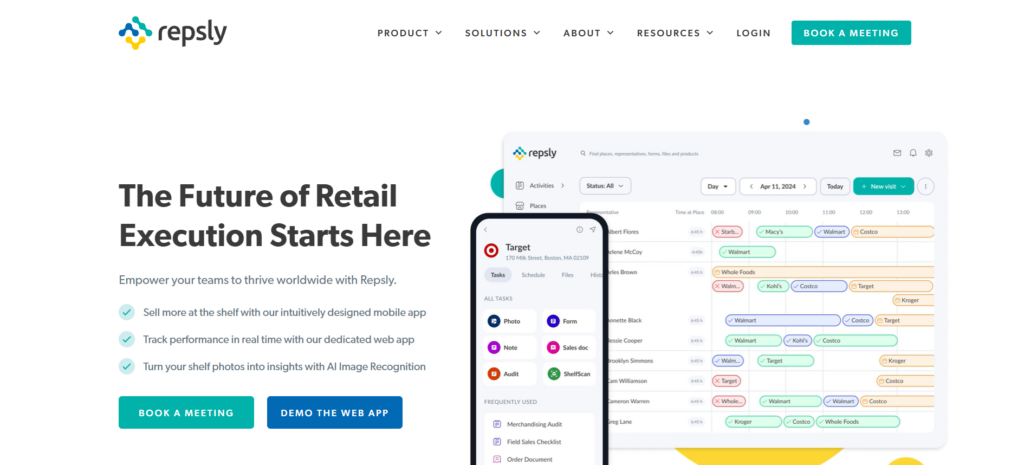
Repsly serves CPG brands and merchandising teams who want reliable in-store visibility and solid audit processes. It’s a dedicated retail execution platform that prioritizes collecting good data from the field and turning it into clear insights, rather than bundling in full sales or distribution tools.
Since its founding in 2008, Repsly has focused on shelf audits, planogram compliance, and monitoring product availability. Field teams use it to run structured visits and gather consistent information across stores.
A standout capability is its AI image recognition feature. This tool reviews shelf photos and automatically detects products and compliance levels, saving time and reducing errors. It also includes competitor tracking and promotion management to help standardize operations across distributed teams.
Main Capabilities
- Visit planning, territory management, and task assignment for field teams
- Real-time web dashboards
- Focused audit tools for shelves, planograms, and availability
- ShelfScan AI for smart photo analysis
Repsly is mainly used for retail execution and field visibility. Users report limitations in reporting depth, integrations, and backend usability, along with occasional syncing issues. (Capterra reviews)
Who Should Still Choose Repsly
Repsly is best suited for mid-sized to large CPG companies and retail service organizations that prioritize in-store visibility and audit accuracy over integrated sales and distribution workflows. Teams focused on merchandising compliance and shelf performance will benefit from its AI-powered image recognition and real-time reporting.
4. GoSpotCheck
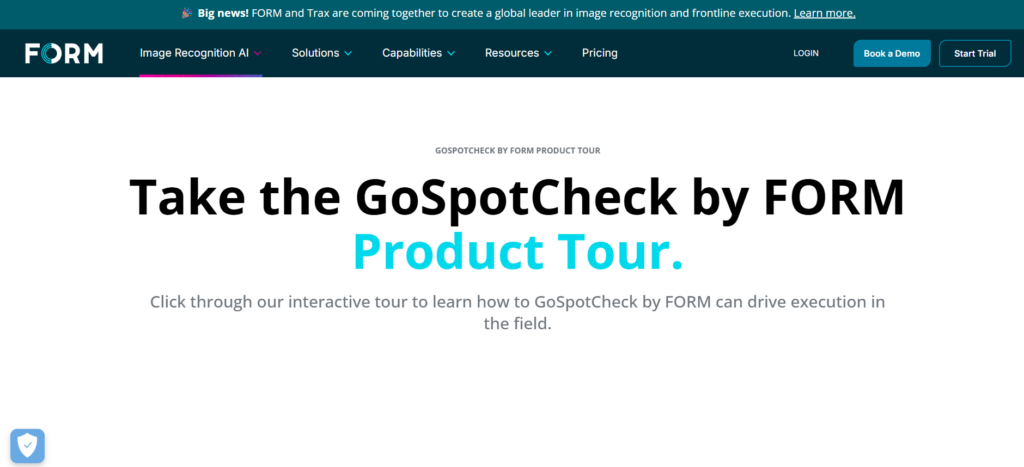
GoSpotCheck is a mobile field execution platform that helps frontline teams follow structured workflows and get real-time visibility into what’s happening on the ground. It recently became part of FORM.
Since its founding in 2011, the platform has been adopted by companies in consumer goods, retail, hospitality, and facilities management. It focuses mainly on task management, collecting data, and tracking compliance during field visits.
Field teams use it to conduct store audits, run surveys, capture photos, and apply standardized checklists across different sites. A particularly useful feature is its image recognition technology, which analyzes photos taken in the field and delivers insights on shelf compliance, product placement, and quality checks.
Key capabilities:
| Feature | Use case |
| Task management | Structured workflows for field visits |
| Image recognition | PhotoWorks AI shelf surveys |
| Workflow building | Customizable task flows |
| Real-time dashboards | Manager visibility into team activity |
GoSpotCheck also includes tools for workflow building, enabling teams to customize task flows based on operational needs. Managers can monitor execution through dashboards that provide real-time insights into team activity and performance.
GoSpotCheck has some limitations. Users report occasional connectivity and performance issues, including slow loading or downtime, as well as inconsistencies in the mobile experience. Some also mention minor usability challenges when managing workflows or configuring tasks. (G2 reviews)
Who Should Still Choose GoSpotCheck
GoSpotCheck is a strong fit for mid-sized and enterprise companies that require scalable audit and task management systems across multiple locations. It is best suited for organizations that prioritize compliance, task execution, and visibility over order capture, invoicing, or DSD workflows.
5. Skynamo
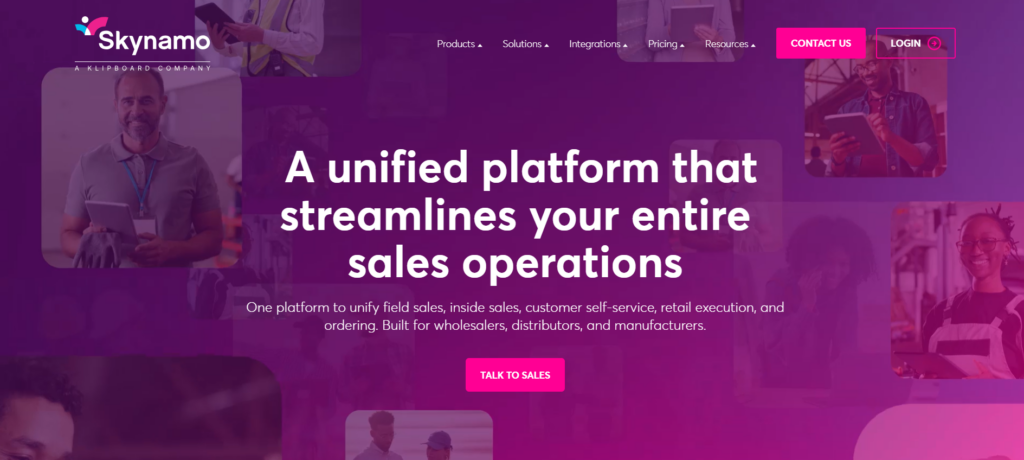
Skynamo is a field sales and B2B sales operations platform designed specifically for manufacturers, wholesalers, distributors, and importers.
What sets it apart is how it helps sales teams stay organized across different regions and channels. It lets them manage customer relationships, capture orders on the go, and coordinate everything in one place. Founded back in 2012, the platform brings together a mobile app for field reps with tools for inside sales and customer self-service.
Salespeople can plan their visits, browse full product catalogs, and enter orders right from a customer’s office. Meanwhile, customers have the option to order through their own branded B2B portal.
On top of that, Skynamo offers solid analytics, reporting, and AI-powered insights through its Radar AI module, which makes it easier to spot trends and understand what’s really happening in your sales data.
Pros & Cons:
| Strengths | Limitations |
| Multi-region, multi-currency support | Limited retail execution capabilities |
| Unified field sales, inside sales, and eCommerce | Core focus on sales workflows, not merchandising |
| AI-driven sales insights (Radar AI) | Quote-based pricing, no published rates |
Skynamo is primarily positioned as a sales operations and order management platform. While it supports some retail execution use cases, its core focus is on sales workflows, customer management, and order processing rather than in-store auditing or merchandising.
Skynamo users report occasional connectivity and syncing issues, along with limitations in reporting, data visibility, and certain feature configurations. (G2 reviews)
Who Should Still Choose Skynamo
Skynamo works particularly well for international B2B sales teams that operate across multiple countries and sales channels. Manufacturers, wholesalers, and distributors — especially those based outside North America — often find it useful when they need solid field sales tools, fast order capture, and customer portals all in one place.
It really shines if multi-currency and multi-region support are important to you.
Conclusion
This comparison evaluated and ranked platforms using a mix of clear criteria, including their market positioning, when they were founded, feature depth, pricing transparency, and regional coverage. We gave preference to those with strong, distinct capabilities in retail execution, field sales, or DSD processes. Tools with incomplete profiles or mostly non-English documentation were excluded.
Importantly, everything here is based on actual available information. We didn’t include any fabricated results or exaggerated claims. The final rankings reflect how well each platform matches the real-world needs of CPG brands and distributors operating across North America.
